
No products in the cart.
Roll over image to zoom in
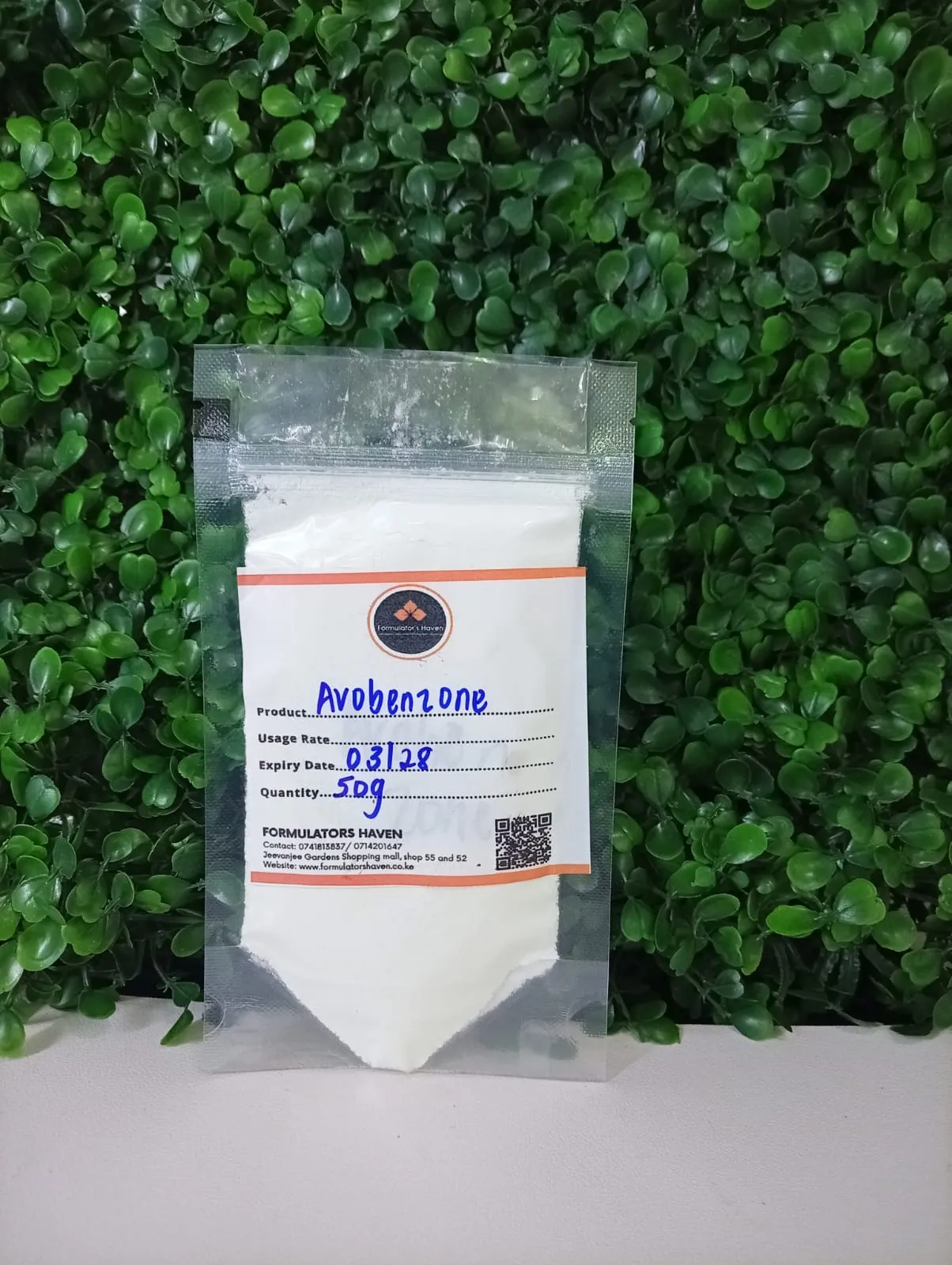
Avobenzone
Price range: KSh 300.00 through KSh 3,000.00
Avobenzone is one of the most widely used UVA filters in sunscreens worldwide. It provides broad UVA protection (320–400 nm), helping to prevent photoaging, DNA damage, and pigmentation caused by long-wave ultraviolet light.
- INCI Name: Butyl Methoxydibenzoylmethane
Oil-soluble (insoluble in water) - UV Absorption Range 320–400 nm (UVA I + UVA II)
- Absorption Peak ~357 nm
- Function: Chemical sunscreen agent (UVA filter)
- Recommended Use Level 0.5–3%; Max allowed 3% (EU), 3% (US), 5% (Japan)
🌞 Function & Importance
- Avobenzone is a UVA absorber that protects skin from photoaging, wrinkles, and pigmentation caused by UVA rays.
- UVA I (340–400 nm): Deep penetration, causes aging
- UVA II (320–340 nm): Contributes to tanning and DNA damage
Description
Avobenzone is one of the most widely used UVA filters in sunscreens worldwide. It provides broad UVA protection (320–400 nm), helping to prevent photoaging, DNA damage, and pigmentation caused by long-wave ultraviolet light.
- INCI Name: Butyl Methoxydibenzoylmethane
Oil-soluble (insoluble in water) - UV Absorption Range 320–400 nm (UVA I + UVA II)
- Absorption Peak ~357 nm
- Function: Chemical sunscreen agent (UVA filter)
- Recommended Use Level 0.5–3%; Max allowed 3% (EU), 3% (US), 5% (Japan)
🌞 Function & Importance
- Avobenzone is a UVA absorber that protects skin from photoaging, wrinkles, and pigmentation caused by UVA rays.
- UVA I (340–400 nm): Deep penetration, causes aging
- UVA II (320–340 nm): Contributes to tanning and DNA damage
Since most UVB filters protect mainly against burning (UVB, 280–320 nm), Avobenzone is essential for broad-spectrum coverage.
Photostability
Avobenzone is photounstable by itself — it breaks down under sunlight, losing up to 50–90% of its effectiveness in an hour if unprotected.
✅ To stabilize it, pair with stabilizers / Synergists such as
1. Octocrylene UVB filter; reduces Avobenzone degradation
2. Tinosorb S (Bis-Ethylhexyloxyphenol Methoxyphenyl Triazine) Broad-spectrum; forms a stable UV filter network
Formulation Tips
- Phase: Oil phase (oil-soluble)
- Melting Point: ~81–86 °C
- Add to: Oil phase and heat gently (80–85 °C) to dissolve completely.
- Best pH Range: 5.5–7.5
- Compatible with: Emollients such as C12-15 Alkyl Benzoate, Caprylic/Capric Triglyceride, or Isododecane.
- Incompatible with: Avobenzone reacts with certain inorganic filters (especially uncoated zinc oxide or titanium dioxide) — this causes instability and discoloration unless coated or encapsulated grades are used.
Key Benefits
- Strong UVA protection (essential for anti-aging sunscreens)
- Works synergistically with UVB filters to deliver broad-spectrum coverage
- Lightweight and flexible, blends well in emulsions and oil-based products
- Compatible with most organic UV filters when stabilized properly
⚖ Regulatory Status
Region Max Allowed Concentration Approval Status
- EU / UK 5% Approved
- USA (FDA) 3% Approved
- Australia 5% Approved
- Japan 5% Approved
- China 5% Approved
Safety
Generally recognized as safe and non-irritating.
May cause mild yellowing in formulas if not stabilized.
Avoid using in highly alkaline formulations (>8).
✅ Summary
Avobenzone is the gold standard UVA filter in modern sunscreens — essential for photoaging and hyperpigmentation prevention.
To maximize performance:
Use stabilizers like Octocrylene or Tinosorb S,
Maintain pH 5.5–7,
Always add it in the oil phase, and
Protect formula from oxidation and light exposure.
Specification
Additional information
| Amount | 100g, 10g, 50g |
|---|
Reviews
There are no reviews yet.